Frank & Stephanie in Portugal
Lisbon
We began our visit to Portugal in Lisbon, the capital. We arrived on our flight from Amsterdam on November 4. We stayed at a nicely remodeled AirBnb apartment in a neighborhood called Ajuda for about three weeks. From there we explored Lisbon and the surrounding areas.
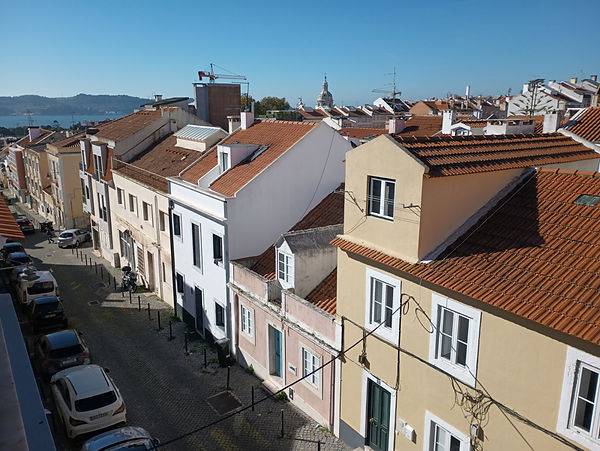
The view from our apartment in Ajuda, Lisbon

Our apartment on Rua das Mercês, Lisbon
On our first full day in Lisbon, we walked along the waterfront of the Rio Tejo, the river that runs through Lisbon and out to the Atlantic Ocean. It was warm and sunny, about 70°F. Not bad for early November.
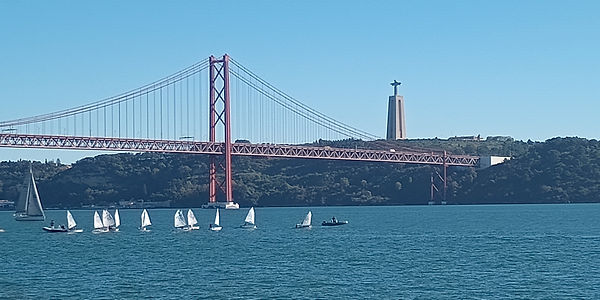
Looking south across the Rio Tejo from Belém. In the distance you can see the Sanctuary to Christ the King, a monument that was inspired by the Christ the Redeemer statue that overlooks Rio De Janeiro, Brazil. In Brazil, the statue sits atop a mountain called Corcovado, immortalized in the classic bossa nova song of the same name by Antonio Carlos Jobim.
At the end of the day we did some grocery shopping and we observed that the grocery prices were about half of what we were accustomed to paying in the U.S. Another way to save money is that in Portugal, as in other European countries, tipping is not expected. That means saving 15-20% on every restaurant meal and taxi ride. It adds up over time. In Europe they pay service workers a living wage so they don't have to depend on the generosity of those who are better off financially.
We took a commuter train to Cais do Sodré, the old central part of Lisbon. We had a nice lunch at an outdoor cafe and took in the sights. Lisbon is very hilly and we walked up to a park called Miradouro São Pedro de Alcantara. "Miradouro" means "view," and we had a good one up there.

x
The view from Miradouro São Pedro de Alcantara. Atop the hill on the left is the Castelo de São Jorge (Castle of Saint George), which dates from the 11th century.
While we were enjoying the view, we struck up a conversation with a young American man from Washington, D.C. He said he worked for the U.S. treasury department, and in that capacity he had visited all five countries in Africa where Portuguese is spoken. He said he was fluent in Portuguese, both the Brazilian and the European varieties. He had been visiting Portugal for a two-week vacation every year for 20 years, so he had a lot of good information for us.
The main thing that we took away from that conversation is that a lot of Portugal gets unbearably hot in the summer, especially inland. It is a real problem because many houses and apartments do not have air conditioning. He said our best bet is to stay near the coast. For the best weather and fantastic natural beauty, he recommended the island of São Miguel in the Azores. Well, we will see about the summer, but dining outdoors in 70°F weather in November is something I could really get used to.
Lisbon is famous for its quaint old trolley cars that still carry passengers around the city. They also have modern streetcars.
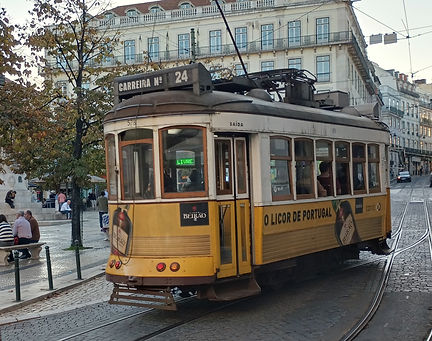
Trolley car near the Biaxa-Chiado metro stop
In Lisbon, many buildings have colorful tiled facades. Some of the sidewalks are tiled as well.

Tiled facades on Calçada da Ajuda, the main street through our neighborhood in Lisbon

Tiled facade on a Farmácia (drug store)
Well, Lisbon has some little cars, too. The color coordination was just perfect, so we had to capture this one. "Pitéu" means "delicacy," so we figured this to be a tiny food truck, probably for selling pastries.
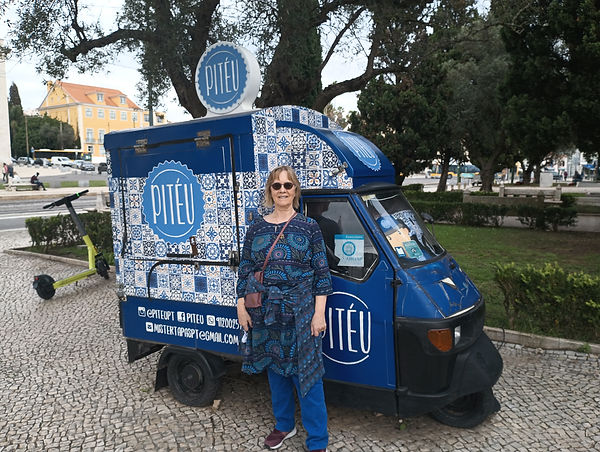
A tiny food truck in the park called Praça Alfredo de Albuquerque
We purchased transit passes that allowed us to ride the trolleys, busses, metro (subway), and commuter trains with just one card. The Portuguese are said to be extremely bureaucratic and a little disorganized, and this was our first experience with that. The day before, we tried to get the passes from a machine at the train station, but the machine didn't work. We asked a clerk at another station and we found that there were several different types of passes, including one that required us to fill out forms and present a picture ID, to be submitted at another station. It was all very confusing, and on our second day trying at yet another station, we were finally able to get the passes that we wanted.
Everyone who describes the expat experience in Portugal mentions the slow, byzantine processes to obtain drivers' licenses and other important documents. Another frequent complaint is that things like getting repairs to your house or apartment can take a very long time, service is unreliable, and work is not always of the best quality. This is something we will have to be prepared for if we want to live in Portugal.
Jardim Botânico da Ajuda (Ajuda Botanical Garden)
I had a couple of free hours one day waiting for a call from our immigration attorney, so I decided to go "off-mission" and visit this great little botanical garden just a few minutes walk from our apartment. The garden was founded on 1768. Though it is very small, it features many interesting tropical plants.

Manicured hedges at the botanical garden

A giant Australian Banyan tree
They had an giant Australian Banyan tree, whose buttressed roots reminded me of the Blue Marble tree that we saw on our visit to Oahu.
At the center of the garden is an impressively ornate fountain depicting sea creatures, both real and fantastic.

Buttressed roots of the Australian Banyan

The fountain at the botanical garden
A blast from the past
One day we were exploring our neighborhood when we heard a strange little flute sound—the same little riff over and over again. We couldn't figure it out until a local man explained to us that it was a guy who walks around with a grinding wheel mounted on a bicycle. He explained that it is something that was very prevalent in times past. When you hear his little pan pipes, you can bring your knives out for sharpening. A few days later, we heard him on our street and I was able to get his picture and record the panpipes that herald his arrival.

When you hear the panpipes, bring out your kitchen knives for sharpening
Listen to the panpipes
In the photo above, you can see cobblestones that pave the sidewalks and many of the streets in Lisbon and other cities. We didn't see very many concrete sidewalks. The cobblestones are often uneven, and sometimes missing stones create a hazard for turning your ankle. Sturdy, flat shoes are a must for walking around in Portugal.

Jerónimos Monastery
The Jerónimos Monastery is a major feature of the Belém section of Lisbon. This huge structure consists of the monastery and the Church of Santa Maria. Both are impressive examples of Manueline architecture (Portuguese late gothic). Construction of the monastery began in 1501 and took 100 years to complete. Considering its massive size and ornate stone carving, it is easy to see why.
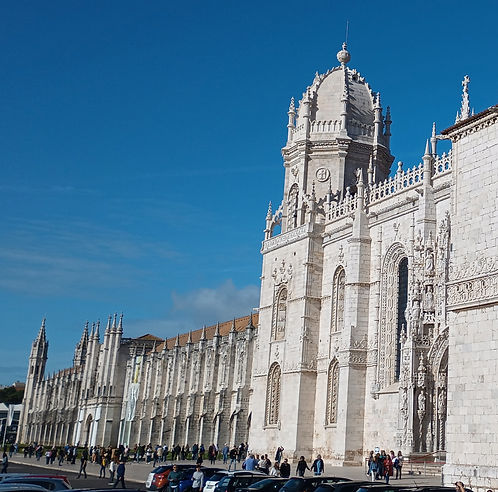
Jerónimos Monastery

Sculpture above the main entrance

Two-story cloister inside the monastery
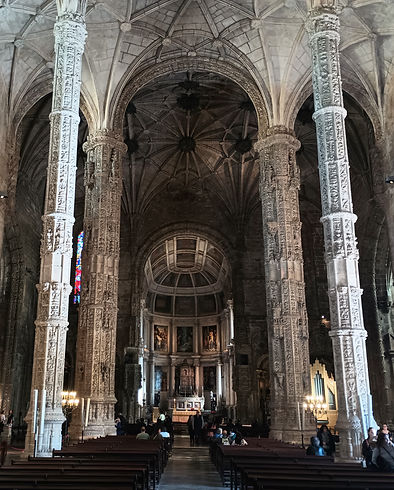
Interior of the Church of Santa Maria
Fado music
Although we didn't hear any jazz in Portugal, we wanted to hear some Fado, a style of music unique to Portugal, and especially associated with the cities of Lisbon and Coimbra.
In the Lisbon style, a singer is accompanied by a guitar (what we would call a classical guitar) and a Portuguese guitar, which has double strings and sounds something like a low-pitched mandolin. "Fado" can be translated as "destiny," or "fate." The music often expresses the somewhat melancholy Portuguese feeling called "saudade," which can be translated as "longing," sort of like American blues.
We heard the music at a restaurant on a street called Rua do Diário de Noticias. There were other Fado houses there and lots of other night life. One thing to know about Fado is that nobody talks while the music is being played. The respectful silence creates a special atmosphere for this haunting music. We heard a singer named Fátima Garcia. She had a beautiful voice. It was too dark to get a picture, but we bought one of her CDs.
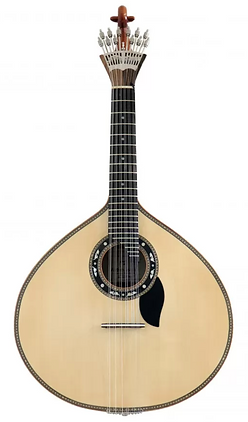
Portuguese guitar
Excerpt from "Estarei Cá Eu" as sung by Fátima Garcia (from her CD "Prece")
A bonus that evening was that we were able to ride one of the antique trolleys back to our apartment. It was cool to see what public transportation was like a hundred years ago.

Inside the trolley

Castelo de São Jorge
On a rainy Tuesday we visited the Castelo de São Jorge, the site of the earliest settlement in Lisbon. The castle was built by the Moors in the 11th century on a site that had been previously occupied by ancient people, including the Romans. The castle offers the best views of Lisbon.
The view across the Tejo River from Castelo da São Jorge on a rainy day

The rooftops of the Alfama section of Lisbon viewed from the castle

Cannon on the ramparts
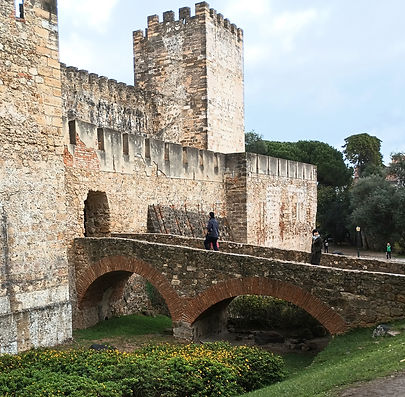
Entrance to the castle
The castle covers a large area atop a high hill in the Alfama section of Lisbon. The stone walls are four or five feet thick and very high. It is something of a maze, with many separate walled-off areas, parapets, and towers. The castle was destroyed in the earthquake of 1755, but it was completely rebuilt between 1910 and 1942, an amazing feat of engineering.

Strolling along the castle walls

Oranges in the garden
Avenida da Liberdade
On our last day in Portugal, we took the bus to the Praça Marquês de Pombal so we could stroll down the Avenida da Liberdade, which is Lisbon's version of the Champs-Élysées. We knew there had to be some wealth somewhere in Lisbon, and here it was.

Praça Marquês de Pombal

Mosaic patterns in the cobblestones
As we walked towards Cais do Sodré, the old part of town, we saw shops for many major fashion brands: Armani, Prada, Luis Vutton, Cartier, and Yves Saint Laurent. I really liked this black shirt, but at €1300, I had to pass.

Father and son swim trunks. €250 for Dad and €150 for junior.

As we came closer to the waterfront and Cais do Sodré, the shops became more affordable and the environment less affluent. By the time we reached the old Central Station building, there was a lot of tourist stuff on offer.

Estacao Central
