Frank & Stephanie in Portugal
Around Lisbon
We visited several places within an hour's drive of Lisbon.
Setúbal
After a couple of days in Lisbon, we were ready to set out for some of the surrounding cities, which would be more affordable than Lisbon. While you can get apartments in Lisbon for under €1,000/month, those would be on the lower end of the price range and probably not very nice. However, if you go to some of the surrounding cities, you can get a much better place for that same €1,000. So we took the bus to Setúbal, a city of about 120,000 people about 45 minutes south of Lisbon.
Setúbal is a seaport and fishing town located on the Sedo River, which flows out to the Atlantic Ocean. We saw a lot of abandoned houses falling into disrepair situated alongside of some very nicely remodeled ones. As we approached the center of town things became more consistently upscale. On that day, the Lisbon area received torrential rains, and parts of Lisbon experienced flooding. Although we were well prepared with rainwear and a big umbrella, we still got pretty wet. We rated Setúbal as a possible expat destination.

The plaza Praça do Brocage in Setúbal on a rainy afternoon
We took the bus back to Lisbon, then took a taxi from the bus station back to our apartment. The cab driver told us that Setúbal has the best seafood in Portugal. We agreed, as we had enjoyed a delicious seafood lunch there for €18, including drinks (that total includes 13% value-added tax on food and 23% on drinks). That cab ride was about 30 minutes through rush hour traffic and cost us only €10.
Amadora
Stephanie developed some foot blisters and knee pain from walking up all of the hills in Lisbon, so one day I went out on my own while she rested at the apartment. I decided to go out to Amadora, a city of about 175,000 people just north of Lisbon. Amadora is easily reached by taking the Lisbon Metro Azul (Blue Line) to the end of the line.
Amadora had lots of apartment buildings, many of them drab and run down. Even with the aid of Google Maps I could not find any evidence of a walkable central district. Amadora did not make the cut on our list of expat destinations.


Apartment buildings in Amadora, with Lisbon in the distance
I did see this funny mural, painted on a wall of one of the many abandoned buildings in Amadora.

Social commentary in Amadora
Returning to Cais do Sodré on the way back to Ajuda, I saw these guys break dancing at small plaza near the Biaxa-Chiado metro stop.

Break dancing at A Brasileira do Chiado
On my way down from the Biaxa-Chiado metro station to the Cais do Sodré train station, I saw a homeless man camped out in a tiny tent alongside a construction site. This was the first homeless person I saw in either Amsterdam or Lisbon after traveling around for 10 days. Lisbon is the biggest city in Portugal, yet the homeless population is not evident. Compare that with the homeless situation on any big American city, such as Portland, where homeless encampments are visible everywhere. What accounts for this disparity?
Odivelas
With Stephanie still recuperating, I took another solo trip, this time to the end of the Metro Amarela (Yellow line). The line terminates at the city of Odivelas, just north of Lisbon. Odivelas was a bit livelier than Amadoro, with some interesting old sections amidst the newer apartment buildings and lots of small shops and cafes.
There was a monastery there that dates back to 1767, with a quiet little park nearby.
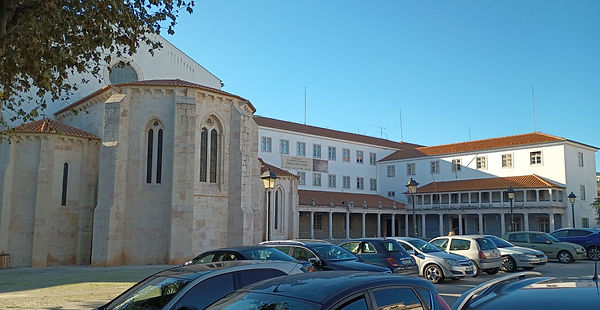
The monastery Túmulo de D. Denis

An old street in Odivelas with high-rise apartments in the distance
On the way back to our apartment, I saw this great old two-tone VW bug beautifully restored. Not really a "tiny car," but so well done I had to include it.

A lovely old VW bug on Calçada da Ajuda
Finally, a trip to the grocery store at the end of the day revealed these giant slabs of salted cod, a seafood offering found all over Portugal. The Portuguese love cod and serve it in a variety of different ways. Look for "bacalhau" on the menu.

Salted cod (bacalhau salgado)
Cascais
We visited Cascais, a city of about 225,000 people, about a 30-minute train ride from Lisbon. Cascais is located on a part of the Atlantic coast called the "Portuguese Riviera" for its Mediterranean-like climate and beautiful beaches. It is considered one of the wealthiest and most expensive areas in all of Portugal. The clean, sandy beaches and the marina are lined with exclusive hotels and gourmet restaurants. We had lunch at one of them, which came in as our most expensive meal to date: starters, entrees, and drinks for €51.
Despite its reputation for being expensive, our immigration attorney assured us that we could get a good apartment there for €1250-1500. It was a very nice place, but even there we could not escape the ever-present graffiti. Nevertheless, we rated Cascais as our first choice expat destination.

Looking across the water from the Cascais Marina to Monte Estoril, another luxury destination on the "Portuguese Riviera"

Boats moored near the Cascais marina

Tiled facade on the Cascais waterfront
Sintra
Sintra is a picturesque town west of Lisbon and north of Cascais. It is an affluent community about a 30-minute train ride from Lisbon. It has several historic castles and palaces, among them the Moorish Castle and the Palacio Nacional da Pena.
We spent the afternoon there and visited the Palacio Nacional, and amazing palace perched high atop a mountain overlooking the city. Originally a 16th-century monastery, it was mostly destroyed in the earthquake of 1755, it was rebuilt in the mid-19th century by King Ferdinand II and used as a residence for Portuguese royalty until the establishment of the Portuguese Republic in 1910. Since that time it has served as a museum and monument, and it has been named a UNESCO World Heritage Site.

Approaching the palace
Although construction was completed in 1854, the palace incorporated medieval and Moorish design elements in a style known as Romanticist architecture.

Detail of the palace entrance

A cloister reminiscent of a medieval monastery

The dining hall with vaulted ceiling

This neat old telephone strangely resembled a human face.