The Eclipse
A few days before we were to leave Portland for Montréal I learned about the upcoming solar eclipse which was to happen on April 8. Montréal was to be at the edge of the “path of totality,” the area where the full effect of the eclipse could be observed.
Back in 2017, when we were living in Eugene, we had the opportunity to see a solar eclipse. Corvallis, just 50 miles north of Eugene, was to be at the center of the path of totality. At that time, I didn’t really “get it,” regarding the nearly manic enthusiasm that some people were expressing about the big event. After all, it gets dark every night, right?

Back then we stayed in Eugene and observed the partial eclipse that was visible just outside the path of totality. It was interesting to watch a partial darkening for a few minutes in the afternoon, but everyone said if you're not in the path of totality you can never understand how great the experience is.
Well, this time I was determined to find out what all the fuss was about. To ensure that we experienced the full effect, we decided to take a 2+ hour bus ride from Montréal to Sherbrooke, a mid-sized city directly in the center of the path of totality.
Of course, everyone in Montréal was talking about the event. In fact, two days earlier I met a guy at the Upstairs jazz club who had come all the way from England just to see the eclipse. He had never seen one before and he was really stoked about it. He had even booked flights to several different locales so at the last minute he could take the one that had the best weather conditions for viewing. On the morning of April 8 he was to take the Amtrak train from Montréal to a place in upstate New York where he expected conditions to be optimal.
Because I had just found out about the event a few days before we were to leave Portland, there was no time to procure the special eclipse glasses that were necessary to safely look directly at the eclipse. I tried to get the glasses in Montréal, but everything was sold out. I learned that you can safely see the eclipse by making something called a pinhole projector using just two pieces of white cardboard. When the big day arrived, we got some white cardboard and headed out to Sherbrooke.
On the freeway out of Montréal, we struggled through a massive traffic jam heading towards the center of the path of totality. We arrived in Sherbrooke a half hour late, but still in plenty of time to have lunch and see the eclipse.
It started about 2:45 in the afternoon, with the peak of totality to occur from 3:29 to 3:32 PM. We took our positions at a plaza across the street from city hall, joining many other eclipse watchers. At 60°F and with clear skies, it made for a comfortable situation. A couple of young men nearby saw us with the pinhole projector and offered us two pairs of the eclipse glasses, as they had extras. Alright! Now there was no way we could fail.
The darkness slowly intensified as we got closer to 3:29. With the glasses we could see the sun gradually being blocked out by the moon. The partially covered sun resembled a crescent moon, although it appeared quite dull through the thick plastic of the lenses. At 3:15 it started to get very dark and quite a bit colder. The crescent gradually got slimmer and slimmer until the sun was completely covered. At that point it was possible to look at the corona without the glasses for a short time.
After 3:32 it began to get light again very quickly, and within five minutes, it was broad daylight and people started to leave.
What to make of such a much-ballyhooed event? Well, it was surely interesting and certainly eerie how quickly it got dark and light again. We appreciated the ability to look at it through the protective glasses, although I found the image to be quite dull—a crescent moon is a lot more beautiful. On the whole I found it to be a little underwhelming.
I wondered about my friend from England and hoped he really enjoyed it. I still don't get it.
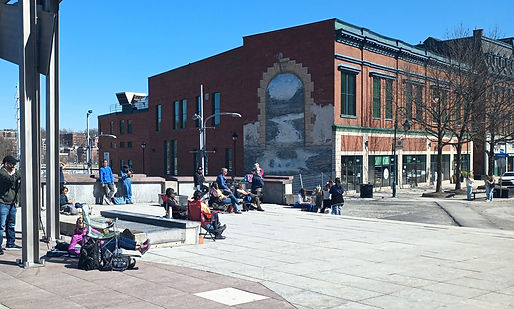
The plaza at 2:45—the beginning of the eclipse

The plaza at 3:30—totality!

Five minutes later...
Bonus: Trompe l'Oeil Murals in Sherbrooke
After the eclipse, we had a few hours to wait for the bus back to Montréal, so we walked around town and took in the sights. Sherbrooke seemed like a fairly ordinary mid-sized city, but we saw four building murals painted in trompe l'oeil style. Trompe l'oeil ("fool the eye" in French) refers to a technique in which an ultra-realistic image is painted on a flat surface in such a way that the objects depicted look three-dimensional and real. The illusion can really fool your eye. In the photos below, can you tell the murals from the real building features? If you look closely at one of them, you can see Stephanie joining the crowd, looking up at the sky through the eclipse glasses.


