


British Museum
We didn't get to spend as much time as we would have liked at the British Museum. We went over there after spending the afternoon at the British Library, and it was getting late. We spent about two hours there before the museum closed.
We decided to focus on the Rosetta Stone and the Parthenon Marbles. The Rosetta Stone was discovered by French troops in Egypt in 1799. The same text is inscribed on the stone in two versions of Egyptian hieroglyphics and Ancient Greek. From this stone, scientists were able to decipher Egyptian hieroglyphics.
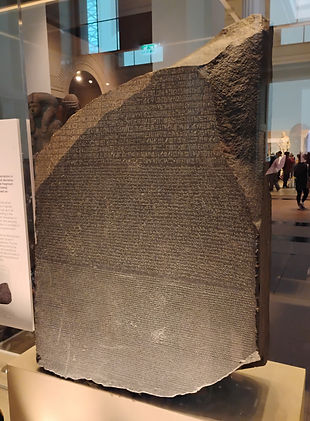
The Rosetta Stone
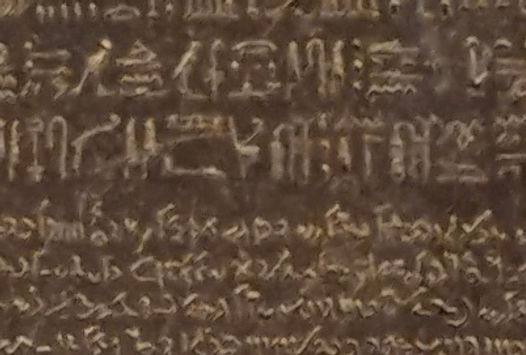
Rosetta Stone (detail)
The Parthenon Marbles are marble relief sculptures from the Parthenon in Greece. They date from the 5th Century BCE.
The British Museum has a room the same size and proportions as the Parthenon in which the sculptures are displayed. They depict a mythological battle between a legendary people called Lapiths and the mythical centaurs.
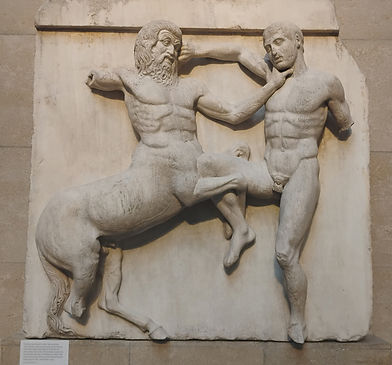
Battle scene from the Parthenon Marbles
On our way to the Parthenon Marbles, we passed two human-headed winged bulls. They are from the Assyrian city of Nimrud, c.865 BCE. They represented protective spirits to guard then entrance to the king's private apartments.

Assyrian human-headed winged bull