


Tate Britain
Tate Britain is devoted to British art, both historical and contemporary. We visited on a rainy Sunday afternoon. Like most great museums, there is too much in there to absorb in a single visit. Here are a few highlights.

Tate Britain

Gargoyles
William Blake (1757–1827) was a poet, painter, and printmaker, and one of the most unusual artists of the Romantic period in England. He is one of the few artists termed a "transformative visionary" in Jose Arguelles' seminal work of art history, The Transformative Vision. In the 1960s, his poems were presented in musical settings by Allen Ginsberg and many others. His artistic work is notable for its mysterious and idiosyncratic style.

William Blake. Lamech and HIs Two Wives 1795. Color print, ink, and watercolor on paper. A Bilblical scene from Genesis—Lamech confesses to his two wives that he murdered a man "for wounding me."
This famous painting from the Romantic period depicts the character Ophelia from Shakespeare's Hamlet. In the play, she drowns in a stream after experiencing several crushing disappointments. The meticulous detail and masterful technique impart an astonishing realism to the image.

John Everett Millais. Ophelia, 1851–1852. Oil on canvas.
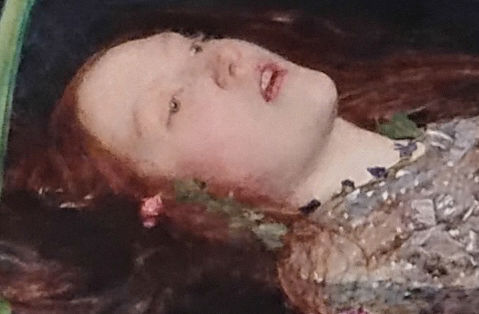
Ophelia, detail
In many of the galleries, they like to insert a modern work in amongst the historical ones. Take a close look at the clock in the next photo. This is a work by Scottish artist Ruth Ewan. It is a functioning "decimal clock," in which each day is divided into ten hours, each hour into 100 minutes, and each minute into 100 seconds. As it turns out, in 1793, the new French government actually adopted a decimal calendar, which lasted for 13 years. I found the decimal clock to be somewhat arresting—you might say, alarming!
I really liked this next one for its subtle quirkiness. It depicts two ladies of the Cholmondeley family, who purportedly were born the same day, married the same day, and gave birth the same day. At first glance, the two images appear to be identical, but on closer examination, you can see that the lace, jewelry, and other details are different.

Ruth Ewan. We could have been anything we wanted to be (red version), 2011. Modified analog clock.

Unknown artist. The Cholmondeley Ladies, c.1600–1610. Oil on wood.