


Greenwich
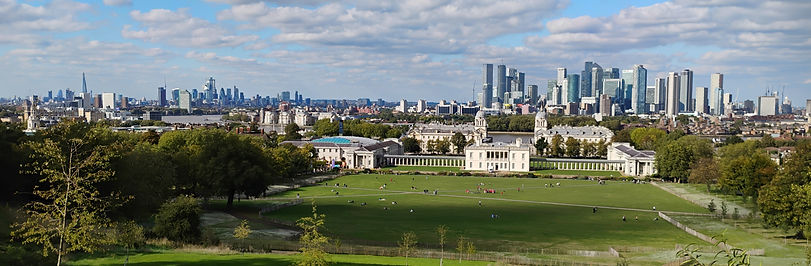
View of London from the Royal Observatory, Greenwich
On Saturday, October 5, the weather was continuing to hold without rain, so we decided to take the bus to Greenwich, a few miles east of central London. Greenwich has a history as a great maritime center. It is home to the Royal Naval College, the Royal Observatory, the National Maritime Museum, the clipper ship Cutty Sark, and many other attractions.
In Greenwich you will find the Prime Meridian, the imaginary line of 0° longitude, which demarcates the eastern and western hemispheres and provides the basis for calculating time zones around the world.
We began our visit by looking at the clipper ship Cutty Sark, the world's fastest sailing vessel until it was retired in the early 20th century. It was famous for carrying cargo from Australia to England in record time. Today you can tour the interior and learn about its illustrious history.
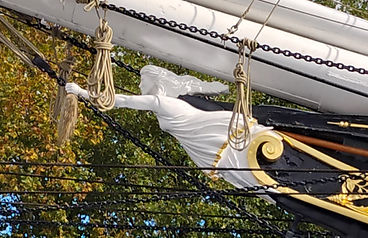
The Cutty Sark figurehead
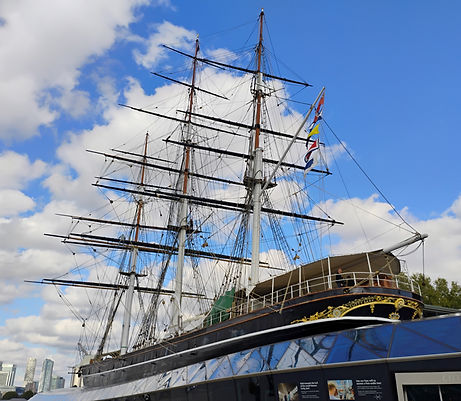
The clipper ship Cutty Sark
Not far from the Cutty Sark, there is a peculiar dome-topped structure that leads down to a pedestrian tunnel under the River Thames. You can walk through the tunnel and emerge on the other side. It was built in the late 19th century to accommodate workers who needed to get across the Thames to Greenwich. The ferries were unreliable due to inclement weather and fog, so they built the tunnel.
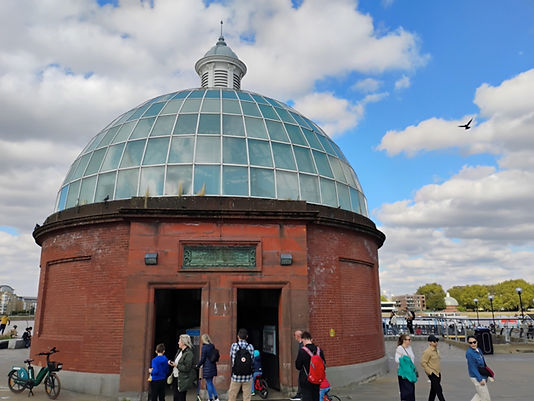
The entrance to the River Thames pedestrian tunnel. If you look carefully, you can see a similar dome in the distance where the tunnel ends on the other side.
We continued our tour past the Royal Naval College, the Chapel of St. Peter and St. Paul, and the National Maritime Museum, towards our ultimate destination: the Royal Observatory, where scientists worked for hundreds of years to understand astronomy and unlock the secret of longitude, a key factor of safe and accurate navigation.

The Royal Naval College
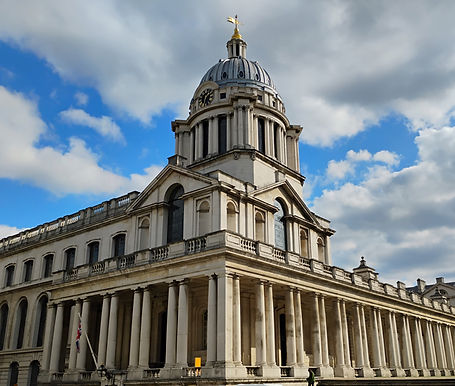
The Chapel of St. Peter and St. Paul
The Royal Observatory sits atop a hill overlooking Greenwich, with the rest of London in the distance. With London being pretty flat, you can see why they built it there. The Observatory consists of several buildings. Many of the exhibits are in the Flamsteed House, named after John Flamsteed, the first Astronomer Royal, who lived there from 1676. They have a lot of old telescopes, clocks, and other scientific equipment. Although I didn't understand all of the theory, it was great to see all that stuff and imagine the excitement of discovery that went on there over the centuries.
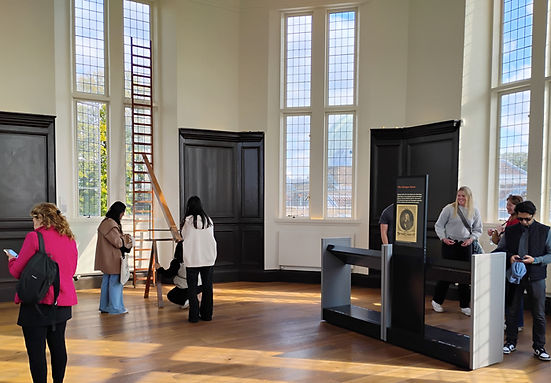
The "Octagon Room" at the top of the Flamsteed House, the original observatory
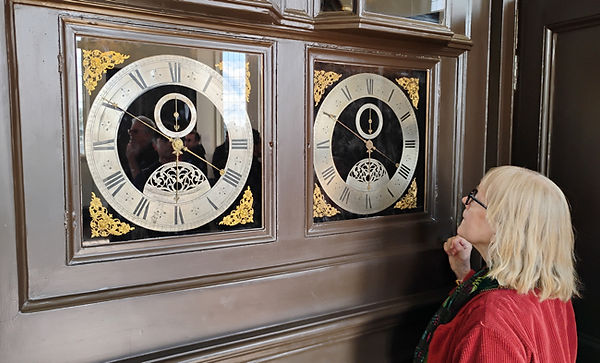
Studying historic clock replicas
We learned that the calculation of longitude depended on the ability to have accurate clocks that could work at sea. The British crown sponsored a competition with a considerable cash prize to anyone who could invent such a clock. The Observatory has five such clocks on display. Here we present a very short video of one of these clocks in operation.
Video of one of the first accurate seafaring clocks
Moving on from the Flamsteed House, we encountered the Astronomy Building and Planetarium. There we saw additional exhibits and more modern telescopes.
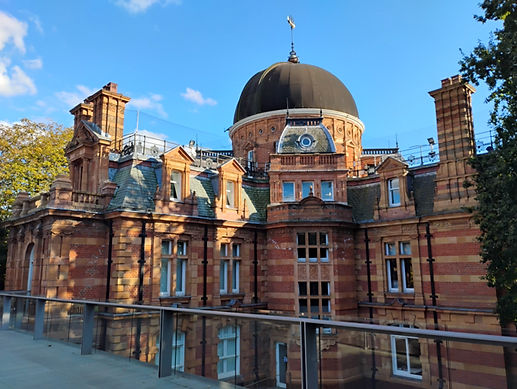
The Astronomy Building and Planetarium
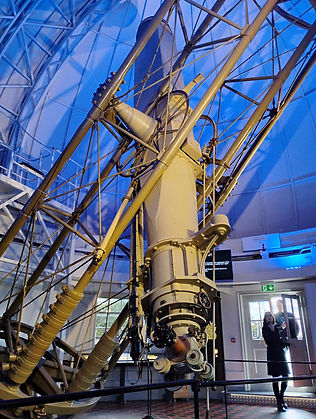
The Great Equatorial Telescope, 1893
And finally, the nerdy pièce-de-résistance: standing on the Prime Meridian and straddling two global hemispheres! They have city names inscribed in the concrete showing which cities are on which side. Stephanie found the part identifying Reykjavik and Helsinki, celebrating her Icelandic-Finnish heritage.
